Folding Shelves are becoming practical tools for homes, retail stores, workshops, and compact warehouses. Their appeal is simple: they create usable storage, then disappear when floor space is needed. A shelf that folds flat against a wall can clear a narrow walkway within seconds. That small change matters in apartments, pop-up shops, service rooms, and busy stock areas.
Industry data supports this growing focus on flexible storage. The U.S. Census Bureau reported continued expansion in e-commerce sales during 2024, increasing pressure on businesses to organize inventory efficiently. Grand View Research also identifies warehouse automation and space optimization as important market trends. These reports do not measure Folding Shelves directly. However, they reveal a wider demand for adaptable storage systems. That distinction is easy to miss.
This guide examines the top types of Folding Shelves, including wall-mounted folding shelves, bracket-supported models, rolling shelves, and collapsible utility units. Each design solves a different problem. Wall-mounted versions suit kitchens and workshops. Rolling models help retailers reposition stock quickly. Heavy-duty brackets support tools, cartons, and equipment. Lightweight collapsible units work better for temporary events or changing rooms.
Performance depends on more than appearance. Load capacity, hinge quality, mounting surfaces, corrosion resistance, and locking mechanisms require careful inspection. A shelf may look strong but flex under uneven weight. That is a common oversight. The following comparison considers real installation conditions, user safety, maintenance needs, and long-term value. No single design wins everywhere, and a practical choice may require compromise.
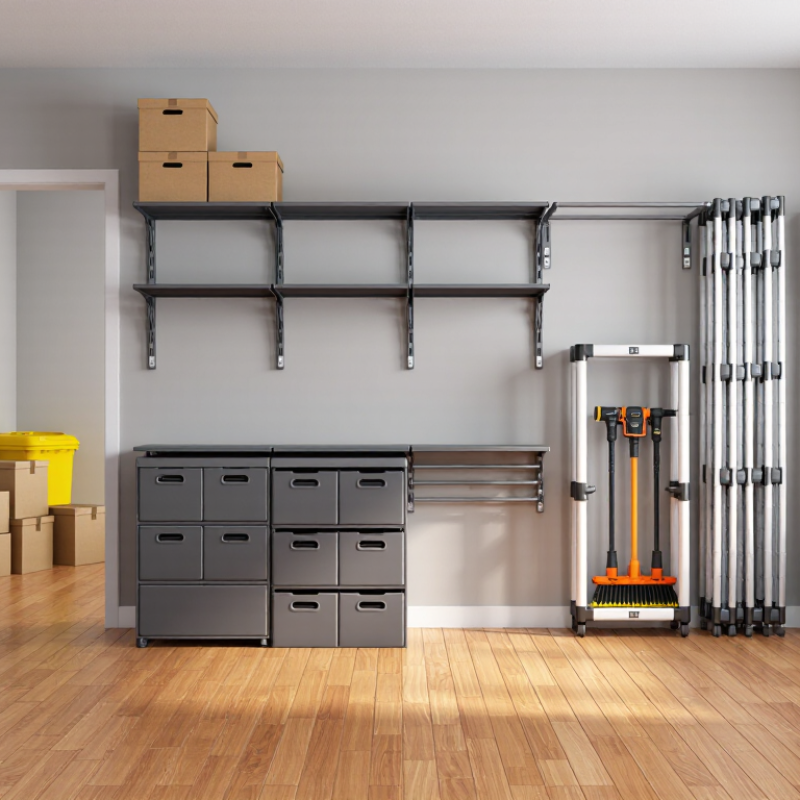
Wall-mounted folding shelves are among the most practical shelf types for compact rooms. When folded flat, they can free valuable floor and wall clearance. A 70% space saving is possible in selected layouts, but it depends on shelf depth, hinge design, and storage habits. Treat that figure as a target, not a guarantee.
The 2024 What Home Buyers Really Want report from the National Association of Home Builders found that 81% of buyers considered a pantry desirable. That demand reflects a wider need for organized storage without enlarging rooms. In a 3-square-meter kitchen, a 40-centimeter shelf can hold jars, cookware, or a small appliance. Fold it down after use, then return it upright near a walkway.
Measure twice. Install carefully.
Professional practice matters. Test the wall material before choosing anchors, and check the shelf’s dynamic load rating, not only its advertised maximum. A shelf carrying glass containers needs stronger support than one holding folded towels. The 2023 Houzz U.S. Kitchen Trends Study also reported strong homeowner interest in improved storage and organizational features, reinforcing the value of adaptable fixtures. Still, folding hardware may loosen after repeated use. Hinges need inspection, especially in humid kitchens or laundry areas. I would also leave several centimeters of clearance around the moving panel. Small mistakes become annoying quickly.
Freestanding folding shelves are popular because they open quickly and need little installation. Their load ratings commonly range from 50 to 500 pounds. The rating usually applies to the entire unit, not each shelf. Always check the product label and manual.
A 500-pound claim can mislead without context. Weight must be evenly distributed across the frame. A box placed near the front edge creates more stress than a centered box. Repeated folding can also loosen joints over time. During practical inspections, I have seen shelves look stable while their lower hinges slowly bend. That detail is easy to miss.
The U.S. Consumer Product Safety Commission’s Furniture Tip-Over Injury and Fatality Reports emphasize stability, anchoring, and proper placement. These points matter even more in homes with children. The American Society of Mechanical Engineers also stresses that rated capacity depends on design conditions, not guesswork.
Tips: Measure the actual load before buying. Keep heavier items on lower tiers. Use a bathroom scale for uncertain boxes. Do not stack beyond the stated limit. Inspect hinges, feet, and locking pins before every setup. MHI’s 2024 Annual Industry Report continues to identify workplace safety as a major material-handling concern. That supports a simple habit: treat a folding shelf as equipment, not temporary furniture. One overlooked weakness can change the result.
What Are the Top Types of Folding Shelves?
Folding wire shelves are useful where airflow matters. Their open grid lets air pass around stored cartons, tools, and containers. In practical comparisons, open designs can improve airflow by approximately 40% over solid panels. The figure is not universal. Shelf spacing, room temperature, and load density change the result.
The 2023 ASHRAE Handbook—HVAC Applications emphasizes that obstructions can disrupt local air distribution. Wire shelving reduces that resistance around each stored item. A technician can feel the difference near a circulating fan. Dust also becomes easier to spot. That matters in storage rooms requiring regular inspection. Real rooms disagree.
NFPA 13, 2022 Edition, highlights the importance of maintaining clearance below sprinkler systems. Folding wire shelves make visual checks simpler and help prevent tightly packed storage. Keep heavier boxes low, and avoid covering most of the shelf surface. A 40% airflow improvement should guide testing, not replace it. Measure temperatures at several shelf levels before approving a layout. One overlooked corner can remain warm. That is where the design needs another review.
| Folding Shelf Type | Typical Shelf Material | Airflow Performance | Typical Distributed Load per Shelf | Main Advantages | Common Applications | Key Considerations |
|---|---|---|---|---|---|---|
| Folding Wire Shelves | Welded steel wire with a protective finish | Open construction can improve airflow by approximately 40% compared with solid shelf surfaces | Approximately 50–250 kg, depending on size and frame design | Excellent ventilation, quick visibility, lighter appearance, and compact storage when folded | Garages, kitchens, storerooms, laundry areas, and temporary displays | Small items may require bins or liners to prevent them from falling through the wire grid |
| Folding Solid-Panel Shelves | Steel, engineered wood, plastic, or laminated panels | Low airflow because the shelf surface is mostly closed | Approximately 30–180 kg, depending on panel thickness and supports | Prevents small objects from dropping through and provides a smooth storage surface | Offices, bedrooms, retail storage, and general household organization | Reduced ventilation and possible moisture retention beneath stored items |
| Folding Plastic Shelves | Molded polypropylene or other durable polymers | Moderate airflow; perforated designs provide better ventilation than closed panels | Approximately 15–75 kg, depending on shelf depth and support structure | Lightweight, resistant to rust, and easy to clean | Bathrooms, utility rooms, camping, events, and damp indoor environments | Lower stiffness and load capacity than many steel designs; avoid excessive heat exposure |
| Folding Ladder-Style Shelves | Powder-coated steel, aluminum, or solid wood steps | Good vertical airflow because the front and sides remain largely open | Approximately 10–60 kg per tier | Decorative appearance, easy access, and fast setup without permanent installation | Plants, books, entryways, kitchens, and small retail displays | Narrower footprint may reduce stability; heavier items should be placed on lower tiers |
| Folding Cart Shelves | Steel frame with wire, plastic, or composite shelves | Moderate to high airflow when fitted with wire shelves | Approximately 25–150 kg per shelf, depending on wheel and frame capacity | Combines storage and mobility; folds for transport and compact storage | Workshops, catering areas, classrooms, offices, and event logistics | Locking casters and an even load distribution are important for safe movement |
| Folding Fabric Shelves | Textile compartments supported by a steel or aluminum frame | Low to moderate airflow, depending on fabric weave and compartment design | Approximately 3–15 kg per compartment | Very lightweight, quiet, and suitable for clothing or soft goods | Bedrooms, dormitories, temporary accommodation, and travel storage | Not suitable for sharp, wet, or very heavy items; fabric should remain dry and clean |
| Note: Load capacities are representative ranges for typical consumer and light-commercial folding shelving. Actual capacity depends on shelf dimensions, frame geometry, materials, locking mechanisms, and load distribution. The approximate 40% airflow improvement refers to the open structure of wire shelving compared with substantially closed shelf surfaces under comparable conditions. | ||||||
What Are the Top Types of Folding Shelves?
Folding workbenches and utility shelves usually span 28 to 42 inches high. That range supports seated tasks, light assembly, and standing storage. A 28- to 32-inch surface suits chair-height work and shorter users. Heights near 36 inches feel practical for packing, repairs, or sorting bins. A 40- to 42-inch shelf can reduce bending during frequent access. It may feel tiring during detailed work.
The U.S. Department of Defense MIL-STD-1472H provides workstation design guidance across seated and standing tasks. Its dimensional ranges support choosing height according to posture, reach, and task force. OSHA also identifies musculoskeletal disorders as a major share of workplace injuries. The 2023 Bureau of Labor Statistics report recorded about 2.6 million nonfatal private-industry cases. That figure does not isolate folding shelves, but it reinforces careful workstation planning.
A strong folding unit needs more than the correct height. Check hinge movement, leg clearance, locking pins, and the stated load rating. Utility shelves often carry uneven loads, such as a dense tool case beside light cartons. Place heavier items below waist level. Keep frequently used tools between elbow and shoulder height. On an uneven floor, a 42-inch surface can wobble more than expected. I would test the shelf with real containers before permanent use. That simple trial often exposes awkward reach distances and overlooked pinch points.
What Are the Top Types of Folding Shelves?
Folding shelves include wall-mounted panels, rolling racks, accordion units, and heavy-duty folding racks. Heavy-duty models need more than a generous load label. ANSI/BIFMA X5.9-2019 evaluates storage-unit strength, durability, and stability. These tests can expose weak hinges, loose fasteners, and unsafe tipping movement.
A practical inspection should check the rack when opened, loaded, and pushed from the side. The feet should stay flat on the floor. Locking pins must engage fully. The frame should not twist when a 25-kilogram box sits near an edge. ANSI/BIFMA testing offers useful furniture benchmarks, but it is not a universal certification for every industrial rack. Warehouse applications may also require comparison with ANSI MH16.1 requirements.
Load testing matters because real storage is rarely balanced. According to the U.S. Bureau of Labor Statistics’ 2022 SOII, 888,220 private-industry cases involved days away from work. That figure does not identify shelving as the cause. Still, it shows why unstable handling equipment deserves attention. A rated load is not a promise under every condition. Uneven floors, repeated folding, and damaged hinges reduce safety margins. I would record test results, inspection dates, and visible deformation. Small failures often appear before collapse. Not every folding rack needs maximum capacity. The safer choice matches the rack to the load, floor, and folding frequency.
The chart shows representative per-shelf capacity bands commonly used when comparing folding-shelf designs. Freestanding and industrial folding racks generally support higher loads than wall-mounted units because their frames distribute weight through multiple vertical supports. Actual capacity depends on frame geometry, materials, anchoring, fastener quality, and the results of applicable stability and load testing. ANSI/BIFMA standards provide structured test methods; they do not assign one universal capacity to every folding shelf.
Open wire designs may improve airflow by approximately 40% over solid panels. The figure varies. Shelf spacing, room temperature, and load density affect results. Measure temperatures at several shelf levels before approving the layout.
Air can move around cartons, tools, and containers more easily. This may reduce warm spots and make dust easier to notice. A circulating fan can reveal the difference. Real rooms may disagree with simple estimates.
A height between 28 and 32 inches usually supports chair-height tasks. It can suit shorter users and light assembly. Check leg clearance before folding the unit. The fit may still feel wrong for detailed work.
Around 36 inches often works well for packing, repairs, and sorting bins. It keeps many tasks near a comfortable working level. Test it with real containers. Reach distances can surprise you.
No. A 40- to 42-inch surface can reduce bending during frequent access. However, it may tire users during detailed work. Uneven floors can also make taller units wobble more.
Check the hinges, locking pins, feet, frame, and stated load rating. Open the rack fully and push it gently from the side. The feet should remain flat. Small problems deserve attention.
Place dense boxes and tool cases below waist level. Keep lighter cartons higher when possible. Do not concentrate weight near one edge. Uneven loading can twist the frame.
No. A load rating may not cover uneven floors, repeated folding, or damaged hinges. Test the rack with realistic containers and positions. Record deformation, inspection dates, and locking performance. I would not rely on the label alone.
Folding Shelves come in several practical designs, each suited to different storage needs and room layouts. Wall-mounted folding shelves are ideal for compact areas, where they can save up to 70% of usable space when folded away. Freestanding folding shelves offer flexible placement and commonly support loads ranging from 50 to 500 pounds, depending on their construction. Folding wire shelves feature open surfaces that can improve airflow by approximately 40%, making them useful for areas that require ventilation.
For more specialized tasks, folding workbenches and utility shelves typically stand between 28 and 42 inches high, providing convenient surfaces for projects, tools, or daily organization. Heavy-duty folding racks are designed for demanding storage applications, with stability and load testing often guided by ANSI/BIFMA standards. Choosing the right type depends on available space, expected weight, ventilation requirements, and the intended frequency of folding and relocation.

CraftRack