Top 10 Types of Pegboard Displays for Global Buyers

Time:2026-10-18 Author:Aria
0%

Choosing the right Pegboard Displays can shape how customers notice, touch, and remember a product. For global buyers, the decision involves more than appearance. Retail fixtures must support different product weights, store layouts, customer habits, and installation conditions. A compact metal board may suit a tool shop, while a framed wooden version can better match a premium lifestyle store. Each option creates a different balance between strength, flexibility, portability, and visual appeal.

This guide examines ten practical types of Pegboard Displays used in retail stores, exhibitions, workshops, warehouses, and promotional spaces. The comparison considers material quality, hole spacing, accessory compatibility, surface finish, packaging, and long-term maintenance. It also highlights details buyers often inspect too late, such as edge protection, mounting stability, corrosion resistance, and replacement-part availability. A display that looks efficient in a catalog may become inconvenient during assembly. That matters.

Reliable sourcing requires clear specifications and honest testing. Buyers should request load-bearing data, product dimensions, installation instructions, sample photographs, and quality-control information before placing large orders. Regional safety expectations and shipping conditions may also influence the final choice. No single format wins every project. Budget, branding, product category, and installation skill all change the answer. Some recommendations here remain flexible because real retail environments are rarely perfect. A crowded aisle, uneven wall, or missing accessory can quickly expose a weak design. Understanding these ten formats helps international purchasers compare suppliers with greater confidence and select displays that work beyond the showroom.
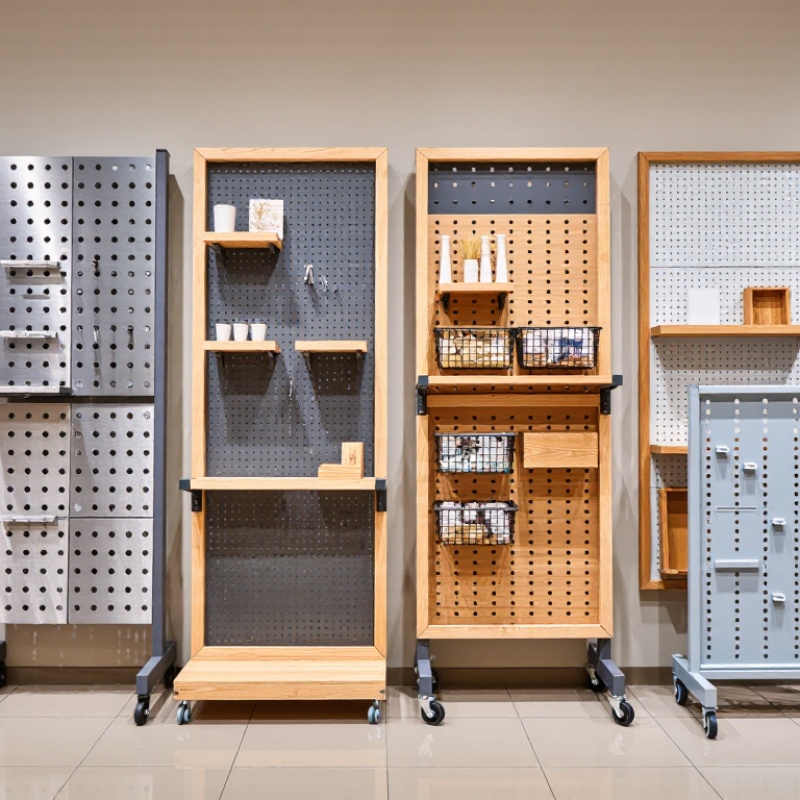
Top 10 Types of Pegboard Displays for Global Buyers

What Pegboard Displays Are and How They Work

Top 10 Types of Pegboard Displays for Global Buyers

What Pegboard Displays Are and How They Work

Pegboard displays are perforated panels used to organize products on walls, counters, and retail fixtures. Their repeated holes accept hooks, shelves, baskets, brackets, and sign holders. A buyer can change the layout without replacing the entire panel. That flexibility matters when product sizes or seasonal campaigns change.

A typical unit uses a rigid backing board, vertical supports, and adjustable accessories. Metal panels often carry heavier tools, packaged hardware, or boxed goods. Wood and composite panels create a warmer presentation for lifestyle products. Hooks position items at eye level, while baskets hold smaller pieces that customers can touch and compare. The system works through spacing, weight distribution, and clear product visibility. Poor spacing still creates clutter.

Grand View Research estimates the global retail shelving market will expand steadily through 2030, supported by store modernization and flexible merchandising needs. Its retail shelving analysis also identifies modular systems as practical solutions for changing store formats. The 2024 Global Powers of Retailing report from Deloitte highlights continued investment in efficient, adaptable retail operations. These findings support pegboard use, but they do not guarantee performance.

In practice, installation quality decides much of the result. A loose anchor can tilt a full panel. An overloaded hook can damage the board. Buyers should verify load ratings, hole spacing, corrosion resistance, packaging protection, and replacement-part availability. I have found that attractive layouts sometimes fail because staff cannot reset them quickly. Simplicity is often more valuable than clever design.

How Pegboard Displays Are Classified by Structure and Application

Top 10 Types of Pegboard Displays for Global Buyers

Pegboard displays are commonly classified by structure and application. Wall-mounted units save floor space and suit retail aisles, workshops, and stockrooms. Freestanding models create visible product zones, while rolling displays can move between departments. Folding pegboards support trade shows and temporary promotions. Countertop units work well near checkout areas, especially for small accessories.

Modular pegboards use interchangeable panels, hooks, shelves, and baskets. Grid-backed versions provide stronger visual openness and flexible attachment points. Slat-and-peg combinations support heavier products, although load limits must be checked carefully. Lockable displays add security for valuable merchandise. Weather-resistant models serve outdoor markets, garden centers, and covered events. These are the ten practical types many global buyers compare.

Application should guide the final selection, not appearance alone. A classroom may need lightweight panels with rounded edges. A workshop often requires reinforced hooks and clear weight ratings. Retail buyers should inspect panel thickness, hole spacing, coating quality, and replacement-part availability. Packaging also matters during international shipping. I have seen attractive units arrive with bent corners because protection was too weak. That detail is easy to miss. A display can look professional yet perform poorly when accessories do not fit standard spacing. Buyers should request drawings, material data, sample testing, and installation instructions before placing larger orders. Regional safety requirements and fire-related rules may also affect material choices. Product categories overlap, so this classification is useful but not perfect.

Top 10 Types of Pegboard Displays for Global Buyers

How pegboard displays are classified by structure and application. The chart compares typical panel widths commonly specified for each display format; values are reference midpoints for product planning and sourcing.

Freestanding and double-sided formats generally provide more merchandising capacity, while countertop, slatwall-converted, and wall-mounted displays are better suited to compact retail areas and permanent fixtures.

Ten Pegboard Display Types for Different Retail Environments

Top 10 Types of Pegboard Displays for Global Buyers

Ten Pegboard Display Types for Different Retail Environments

Wall-mounted pegboards suit narrow shops and place small products at eye level. Freestanding single-sided units work well along walls without drilling. Double-sided floor displays guide shoppers through open aisles. Countertop pegboards keep compact accessories near checkout areas. Rotating towers add visibility where floor space is limited. Space changes everything. Their hooks should match product weight and package size.

Gondola-style pegboard displays create organized runs for supermarkets and larger stores. Corner pegboards use awkward spaces for seasonal goods or trial collections. Rolling pegboards support frequent layout changes during promotions and inventory checks. Lockable pegboards offer added control for higher-value merchandise in staffed retail areas. Folding pegboards help temporary shops, exhibitions, and mobile sales teams. Keep it simple. A crowded panel can reduce product visibility.

Modular pegboards allow shelves, baskets, hooks, and signage to move as stock changes. Backlit pegboards can improve attention in darker interiors, but lighting needs careful testing. In retail planning, I have found that the strongest display is not always the largest. A small countertop unit may outperform a tall tower near a busy payment area. Measure twice. Some panels look efficient on paper, yet become difficult to restock. Buyers should test reach height, aisle clearance, load capacity, and cleaning access before approving a final design.

Key Materials, Sizes, Accessories, and Customization Options

Top 10 Types of Pegboard Displays for Global Buyers

Material selection shapes strength, cost, and shipping risk. Steel pegboards suit tools, hardware, and heavier packaged goods. MDF boards offer a warmer appearance and easier routing. Plastic panels resist moisture, but they may flex under concentrated loads. A 2024 U.S. Census Bureau report recorded US$1.12 trillion in retail e-commerce sales during 2023. That figure suggests stores need flexible displays for online-to-offline product collection.

Common board sizes include 600 × 900 mm, 900 × 1200 mm, and 1200 × 2400 mm. Smaller panels fit counters and narrow aisles. Larger sheets support wall systems and dense product presentation.

Hole spacing matters. A 25 mm pitch supports many metric accessories, while a 1-inch pitch suits inch-based supply chains. Hooks, baskets, shelves, sign holders, brackets, and locking clips expand the display’s function. Keep spare hooks nearby. They disappear quickly.

Customization can include powder coating, rounded corners, printed headers, reinforced edges, and tailored hole patterns. For international orders, confirm load ratings, carton dimensions, assembly methods, and local safety requirements.

ISO 7170 testing principles can help buyers evaluate storage-unit strength, although pegboard applications still require product-specific checks.

A perfect board rarely exists. I would avoid excessive customization when replacement parts are uncertain. Standard accessories often reduce long-term maintenance, even when the initial design looks less distinctive.

How Global Buyers Evaluate Suppliers and Select the Right Display

Global buyers evaluate pegboard displays as retail equipment, not just attractive panels. POPAI’s Mass Merchant Shopper Engagement Study found that 76% of purchase decisions happen in stores. That figure makes visibility, product access, and shopper movement essential supplier criteria. Buyers should compare steel thickness, hook loading, edge finishing, and spacing accuracy. Ask for assembly drawings and carton dimensions. A display that looks strong may arrive with bent hooks or unstable feet.

Supplier reliability needs measurable evidence. Request material specifications, inspection records, sample photos, and a small pre-production order. ISO 9001 certification can indicate controlled processes, but it does not replace physical inspection. The 2023 Global E-waste Monitor highlights growing waste pressure, so buyers should also check recycled content, repairability, and packaging volume. Modular pegboards often perform better when hooks and shelves can be replaced instead of discarding the full unit. Freight data matters too. A compact carton can reduce storage costs and damage risk.

I once focused too heavily on surface finish. That was a mistake. The first shipment looked polished, yet the hook spacing did not match local product packs. Buyers should test displays with real merchandise, gloves, shelf labels, and store lighting. Supplier selection becomes clearer when evaluation scores include durability, lead time, documentation, customization control, and after-sales response. Price still matters. It should not carry the most weight.

Top 10 Types of Pegboard Displays for Global Buyers - How Global Buyers Evaluate Suppliers and Select the Right Display

Rank Pegboard Display Type Typical Structure and Materials Common Applications Typical Size Range Typical Load Capacity Main Advantages Common Limitations Key Supplier Evaluation Points Best Fit for Global Buyers
1 Wall-Mounted Pegboard Display Perforated steel, MDF, plywood, or plastic panel fixed directly to a wall with brackets or rails. Hardware stores, tool sections, workshops, home organization, and retail back walls. Approximately 600–2,400 mm wide and 600–2,400 mm high; custom sizes are common. Usually 5–20 kg per hook or shelf, depending on panel material and wall fixing. Space efficient, easy to expand, and suitable for a broad range of hooks and shelves. Requires a suitable wall and secure installation; relocation is less convenient. Panel thickness, hole spacing, mounting hardware, coating durability, packaging protection, and installation instructions. Permanent retail fixtures and organized product presentation.
2 Freestanding Pegboard Display Double-sided or single-sided perforated panels supported by a steel or aluminum base. Retail aisles, trade shows, pop-up shops, showrooms, and promotional areas. Approximately 600–1,200 mm wide and 1,200–2,100 mm high. Typically 30–100 kg total, depending on the base, panel, and weight distribution. Does not require wall installation and can create displays in open floor space. Uses valuable floor area and may require ballast or a wider base for stability. Base stability, anti-tip performance, assembly time, flat-pack dimensions, and total shipment volume. Flexible retail layouts and temporary merchandising programs.
3 Mobile Pegboard Display Freestanding pegboard mounted on a wheeled steel frame, usually with locking casters. Retail campaigns, warehouse picking areas, classrooms, studios, and event environments. Approximately 600–1,000 mm wide and 1,200–2,000 mm high. Typically 30–80 kg total, depending on wheel size and frame construction. Easy to move, reposition, and store; supports frequent floor-plan changes. Casters increase cost and height; overloaded panels can become difficult to move safely. Caster quality, wheel locks, frame welds, center of gravity, noise during movement, and spare-part availability. Markets where displays must be frequently relocated or reconfigured.
4 Countertop Pegboard Display Compact perforated panel or small framed board made from steel, MDF, acrylic, or plastic. Checkout counters, reception desks, specialty retail, cosmetics, stationery, and small accessories. Approximately 250–600 mm wide and 300–900 mm high. Usually 5–25 kg total, with lower capacity for lightweight plastic or acrylic versions. Low shipping volume, quick setup, and effective use of counter or shelf space. Limited capacity and visibility; unsuitable for large or heavy merchandise. Footprint, tipping resistance, edge finishing, compact packaging, accessory compatibility, and color consistency. Small products, impulse merchandising, and counter-level displays.
5 Gridwall-Pegboard Hybrid Display Wire grid panels combined with perforated boards, hooks, baskets, or shelves. Apparel accessories, general merchandise, craft products, exhibitions, and seasonal promotions. Approximately 600–1,200 mm wide and 1,200–2,100 mm high. Typically 20–80 kg total, depending on the wire gauge, board material, and base. Combines open visibility with flexible hanging and shelving options. Mixed components may have different finishes, tolerances, or accessory standards. Compatibility between systems, connector strength, finish matching, replacement accessories, and assembly fit. Buyers needing multiple merchandising methods in one display.
6 Slatwall and Pegboard Combination Display Horizontal slatwall sections integrated with perforated pegboard panels and metal or plastic accessories. Retail stores, tool displays, consumer goods, sports accessories, and showroom walls. Approximately 600–2,400 mm wide and 600–2,400 mm high. Usually 10–30 kg per accessory position, subject to the panel and fixing method. Offers both hook-based hanging and shelf-based merchandising in one fixture. Heavier and more complex than a single-system display; accessories may not be interchangeable. Panel alignment, load distribution, accessory standards, surface durability, installation labor, and replacement policy. Permanent stores with varied product sizes and presentation requirements.
7 Gondola Pegboard Display Retail gondola frame with one or two pegboard backs, shelves, base decks, and optional headers. Supermarkets, hardware stores, pharmacies, convenience stores, and warehouse retail. Commonly 900–1,200 mm wide and 1,200–2,100 mm high; aisle runs can be extended modularly. Often 100–300 kg per bay when properly assembled and evenly loaded. High capacity, modular expansion, double-sided merchandising, and efficient aisle use. Requires more floor space, more assembly, and stronger logistics planning. Bay compatibility, shelf load ratings, base stability, uprights, packaging, installation labor, and spare parts. High-volume retail environments requiring durable modular fixtures.
8 Lockable Pegboard Display Cabinet Perforated back panel inside a cabinet with glass, polycarbonate, or metal doors and a lock. High-value tools, electronics accessories, collectibles, medicines, and controlled merchandise. Approximately 600–1,200 mm wide and 900–2,100 mm high. Typically 20–100 kg total, depending on shelves, door construction, and cabinet frame. Improves security, reduces product handling, and supports organized visual presentation. Higher purchase and freight cost; access is slower than with an open display. Lock quality, hinge durability, glazing safety, ventilation, shelf adjustment, key control, and anti-tip design. Products requiring controlled access or additional theft protection.
9 Outdoor or Weather-Resistant Pegboard Display Powder-coated steel, galvanized steel, aluminum, treated board, or UV-resistant polymer components. Garden centers, outdoor markets, building-material displays, events, and service stations. Approximately 600–1,200 mm wide and 1,200–2,100 mm high. Typically 20–80 kg total; wind exposure may reduce the practical working load. Designed for moisture, sunlight, and temperature variation when correctly specified. Weather resistance does not eliminate corrosion risk, wind risk, or maintenance requirements. Coating thickness, corrosion testing, UV resistance, drainage, anchoring method, wind stability, and maintenance guidance. Outdoor or semi-outdoor merchandising where environmental exposure is expected.
10 Custom Modular Pegboard System Configurable combination of panels, towers, shelves, baskets, hooks, signage, lighting, and branded color options. International retail rollouts, exhibitions, showrooms, franchise formats, and multi-category merchandising. Project-specific; commonly built from modules 300–1,200 mm wide and 300–2,400 mm high. Project-specific; commonly 10–30 kg per accessory position when engineered correctly. Supports tailored layouts, repeatable rollouts, category changes, and localized configurations. Higher design, sampling, tooling, coordination, and quality-control requirements. Technical drawings, prototype approval, tolerance control, component interchangeability, export packaging, compliance documents, and after-sales support. Global buyers managing multiple locations or complex display specifications.

Typical dimensions and load capacities are indicative industry ranges. Actual performance depends on material thickness, fixing method, accessory design, weight distribution, installation quality, and local safety requirements.

FAQS

What is a pegboard display?

It is a perforated panel for organizing products on walls, counters, or retail fixtures. Its holes accept hooks, shelves, baskets, and signs. Layouts can change without replacing the whole panel.

How does a pegboard display work?

Hooks hold hanging products at visible heights. Baskets contain small items for easy comparison. Shelves support boxed goods. Good spacing prevents clutter and improves restocking.

Which pegboard type suits a small shop?

Wall-mounted panels fit narrow spaces and keep products near eye level. Countertop units work well beside checkout areas. Rotating towers save floor space. Measure aisle clearance carefully.

What display types suit changing store layouts?

Rolling and modular displays are useful for promotions and inventory changes. Folding units suit temporary shops and exhibitions. Freestanding units avoid wall drilling. Simplicity helps staff reset displays faster.

Which material should buyers choose?

Steel suits tools, hardware, and heavier packaged goods. Wood-based panels create a warmer appearance. Plastic resists moisture but may flex under heavy loads. The cheapest material may not be the best choice.

What sizes and hole spacing are common?

Common panel sizes include 600 × 900 mm and 900 × 1200 mm. Larger sheets support wall systems. A 25 mm pitch suits metric accessories. A one-inch pitch suits inch-based accessories.

What accessories can be used with pegboard displays?

Common options include hooks, baskets, shelves, brackets, sign holders, and locking clips. Match each accessory to the product weight. Keep spare hooks nearby. They disappear quickly.

What should buyers check before installation?

Verify load ratings, anchor strength, hole spacing, corrosion resistance, and packaging protection. Check assembly instructions and replacement-part availability. A loose anchor can tilt a full panel. An overloaded hook can damage the board.

How can buyers improve product visibility?

Place popular products at eye level. Leave enough space between packages. Use baskets for small items and shelves for boxes. Test cleaning access and restocking reach. A larger display is not always better.

Conclusion

Pegboard Displays are flexible retail fixtures that use a perforated panel and compatible hooks, shelves, baskets, or brackets to organize and present merchandise. Their modular structure allows products to be arranged vertically, adjusted quickly, and displayed in limited spaces. This article explains how pegboard displays are classified by construction and application, covering wall-mounted, freestanding, countertop, rotating, slat-integrated, grid-based, portable, illuminated, lockable, and custom-designed options for stores, trade areas, showrooms, and temporary promotions.

It also reviews key considerations such as steel, wood, plastic, and composite materials, along with standard and customized sizes, finishes, load capacity, accessories, packaging, and installation requirements. For global buyers, selecting the right supplier involves comparing product quality, production consistency, customization capability, safety standards, communication, lead times, shipping efficiency, and after-sales support. By matching display structure and features with product weight, store layout, customer access, and budget, buyers can create organized, durable, and adaptable merchandising solutions for different retail environments.

Aria

Aria

Aria is a dedicated marketing professional with a deep passion for innovative strategies and a keen understanding of our company's product offerings. With a wealth of experience in the industry, Aria excels at crafting engaging content that highlights the unique features and benefits of our......