China’s Mobile Shelving industry is becoming more important as warehouses, libraries, archives, and offices seek higher storage density. Grand View Research reported that the global warehouse automation market reached USD 20.19 billion in 2023. It also forecasts strong growth through 2030. Mobile shelving supports this direction by reducing fixed aisles and using floor space more efficiently. However, density alone does not guarantee value.
Warehouse-design expert John J. Bartholdi III states, “The purpose of a warehouse is to provide storage with minimum expense.” This principle applies closely to Mobile Shelving selection. A quality system should combine smooth carriage movement, reliable anti-tilt protection, durable steel frames, and clear load ratings. China’s leading manufacturers and suppliers increasingly offer electric, mechanical-assist, and manual systems. Some also provide barcode control, access permissions, and fire-safety integration. These details matter when shelves hold heavy archive boxes or thousands of library volumes.
Still, supplier comparisons are not always straightforward. Market reports from Fortune Business Insights and MarketsandMarkets describe expanding demand for automated storage and retrieval solutions, yet they rarely separate Mobile Shelving from larger automation categories. That limitation deserves attention. Buyers should verify product testing, warranty terms, installation experience, and after-sales response instead of trusting impressive catalog images. A narrow aisle may save space, but it can also restrict movement during emergencies. The best China Mobile Shelving manufacturers therefore balance capacity, accessibility, safety, and long-term maintenance. Cost matters. It is not everything.
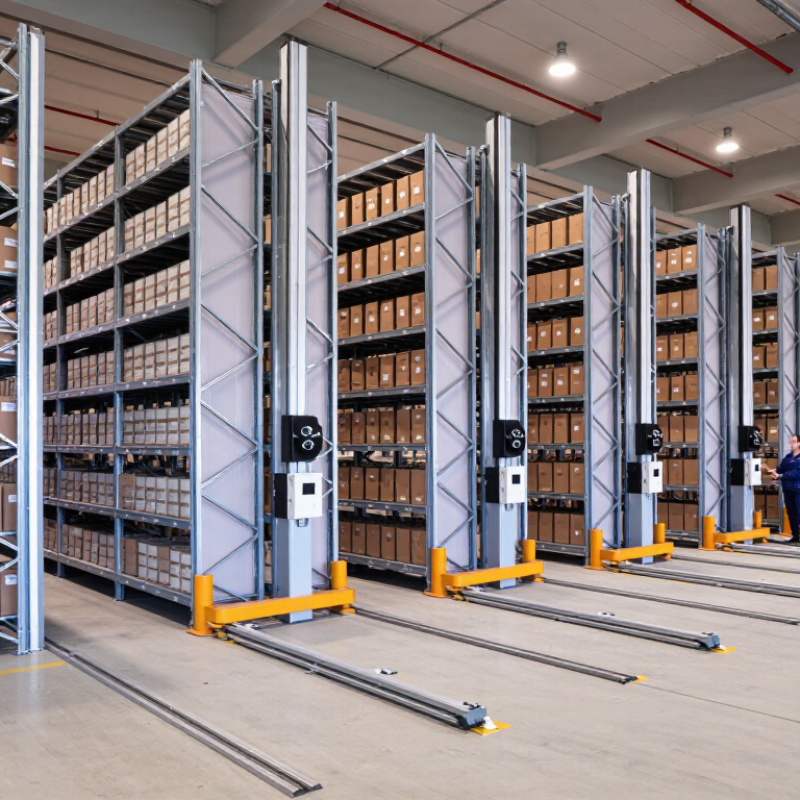
Mobile shelving is a storage system built on movable bases. These bases run along fixed floor rails, allowing several units to close together. A handwheel, chain, or motor moves each unit sideways. Users open one aisle only where access is needed.
Imagine a records room with six rows. Traditional shelving leaves five permanent aisles. Mobile shelving can reduce that unused space. Turning the wheel moves a loaded section smoothly, while guide rails keep it aligned. Mechanical locks prevent movement during loading. Motorized versions may include sensors, emergency stops, and access controls.
The system needs accurate planning. The floor must support concentrated loads and remain level. Uneven flooring can cause resistance, noise, or premature wear. Shelves should match the stored materials, from folders to archive boxes. Heavy items belong on lower levels. Clear labels also reduce repeated movement.
A practical installation check should measure doorways, ceiling height, aisle width, and emergency routes. Safety requirements vary by building and location. Do not treat them as optional. In daily use, staff should inspect rails for dust and check handles for looseness. Small problems become expensive quickly. I have seen space calculations look excellent on paper, yet fail when doors or columns were overlooked. A second site measurement is often worth the extra time.
| Data Category | Key Dimension or Feature | Typical Data or Range | Description and Practical Considerations |
|---|---|---|---|
| Product Definition | Mobile shelving | Shelving units mounted on movable bases | The bases move along floor-mounted rails so multiple shelving rows can be compacted together while one or more access aisles are opened when required. |
| Operating Principle | Movement method | Manual, mechanical-assist, or electric drive | Manual systems use handwheels or handles. Mechanical-assist and electric systems reduce the effort needed to move longer or heavier shelving runs. |
| Space Utilization | Potential floor-space saving | Approximately 30%–50% compared with fixed shelving layouts | The actual saving depends on the number of rows, shelf depth, aisle width, building columns, fire exits, and required working clearance. |
| Storage Capacity | Capacity per shelf level | Approximately 50–150 kg per level for light- and medium-duty shelving | The safe working load must be confirmed for the complete system. Load ratings should account for shelf span, frame design, base length, and evenly distributed weight. |
| Shelf Dimensions | Common shelf width | 600–1,200 mm | Narrow shelves suit files and small cartons, while wider shelves are useful for archive boxes, containers, and general inventory. |
| Shelf Dimensions | Common shelf depth | 300–600 mm | Depth should match the stored items. Excessive depth can reduce visibility and make manual retrieval less convenient. |
| System Dimensions | Typical shelving height | 1,200–2,400 mm | The selected height should allow safe access, adequate overhead clearance, and compliance with local building and fire-safety requirements. |
| Access Aisle | Typical clear aisle width | 800–1,200 mm for manual retrieval | The required aisle depends on user access, trolley dimensions, accessibility requirements, emergency egress rules, and the type of stored materials. |
| Drive Configuration | Base movement arrangement | Single-row or multi-row mobile bases | Single-row bases are suitable for simpler installations. Multi-row systems can provide higher density but require coordinated movement and careful load distribution. |
| Rail System | Rail installation | Surface-mounted or recessed floor rails | Surface rails are generally faster to install. Recessed rails provide a flatter floor surface but may require more preparation and construction work. |
| Control Method | User controls | Handwheel, push-assist, keypad, or control panel | Electric controls may include aisle selection, access authorization, status indicators, and emergency-stop functions. |
| Safety Features | Common protection systems | Emergency stop, obstruction detection, anti-tip protection, and end stops | Safety equipment should be selected according to the system drive type, operating environment, local regulations, and risk assessment. |
| Construction | Common materials | Powder-coated steel frames, steel shelves, and steel drive bases | Steel construction provides structural strength and durability. The coating should be suitable for the humidity, temperature, and cleaning conditions of the installation site. |
| Installation | Floor requirements | Level, stable floor with suitable load-bearing capacity | Floor flatness and loading must be checked before installation because concentrated loads from mobile bases can exceed those of ordinary shelving. |
| Energy Use | Power consumption | Manual systems: none; powered systems: used only during movement | Powered units normally consume energy while opening, closing, or positioning an aisle. Actual consumption depends on motor size, movement frequency, system length, and load. |
| Typical Applications | Suitable storage environments | Archives, libraries, offices, warehouses, museums, healthcare storage, and spare-parts rooms | Mobile shelving is most valuable where storage density is important and the inventory is accessed periodically rather than continuously. |
| Best-Fit Inventory | Stored item characteristics | Files, books, cartons, boxed records, tools, components, and small packaged goods | Items should be arranged by size, weight, retrieval frequency, and security requirements to maintain stability and efficient access. |
| Advantages | Primary benefits | Higher storage density, flexible aisle access, and reduced unused floor area | The system can increase capacity within an existing room without adding another storage area, provided structural and safety requirements are satisfied. |
| Limitations | Main considerations | Higher initial cost, slower simultaneous access, and greater installation complexity | Only selected aisles may be available at one time, and the system may require floor preparation, electrical work, maintenance access, and user training. |
| Selection Criteria | Information required before purchase | Room dimensions, inventory load, shelf size, access frequency, floor condition, and safety requirements | Accurate site measurements and a storage-volume calculation help determine the number of rows, base length, aisle configuration, drive type, and total system capacity. |
Note: The figures shown are typical planning ranges for general mobile shelving applications. Final dimensions, load ratings, aisle widths, electrical specifications, and safety provisions should be verified through a site survey and applicable local standards.
Mobile shelving uses movable bases that travel along fixed floor rails. Units close together when storage access is unnecessary. Users open one aisle only where needed.
Traditional shelving keeps several permanent aisles open. Mobile shelving removes most unused aisle space. A handwheel, chain, or motor moves each section sideways.
Look for mechanical locks, anti-tip interlocks, emergency releases, and reliable braking. Motorized systems may include sensors and emergency stops. Test movement under load.
Measure doorways, ceiling height, aisle width, floor level, and emergency routes. Confirm that the floor supports concentrated loads. Columns can ruin an otherwise excellent layout.
Place heavy boxes on lower levels. Match shelf depth to folders, cartons, tools, or archive boxes. Clear labels reduce unnecessary movement.
Uneven floors may create resistance, noise, and premature rail wear. Units might travel less smoothly. Measure the floor carefully.
Request steel thickness, coating details, weld records, load tests, and inspection documents. Examine rail alignment and frame stability. Attractive photographs prove little.
Provide room dimensions, storage-item sizes, floor capacity, ceiling height, and access routes. Ask for drawings, load calculations, wiring plans, and revision records.
Inspect rails for dust and handles for looseness. Confirm locks, aisle clearance, emergency access, and braking performance. Small faults become expensive quickly.
This guide explains how Mobile Shelving systems maximize storage capacity by placing shelves on movable bases that open only where access is needed. It introduces key options for offices, archives, warehouses, libraries, and industrial environments, including manual, mechanical-assisted, and electrically operated systems. By comparing different layouts, load capacities, shelf configurations, and space requirements, buyers can identify the most suitable solution for their storage needs.
The article also explores why Chinese manufacturers and suppliers are considered for their production flexibility, competitive pricing, and ability to support customized projects. It outlines how to evaluate material quality, structural stability, safety features, surface treatment, and compliance documentation before purchasing. In addition, readers will learn about the typical buying process, including design confirmation, quotation, sample review, production, delivery, installation, staff training, warranty coverage, and after-sales support. These considerations help buyers select reliable Mobile Shelving products and establish efficient, safe, and long-lasting storage systems.

 CraftRack